
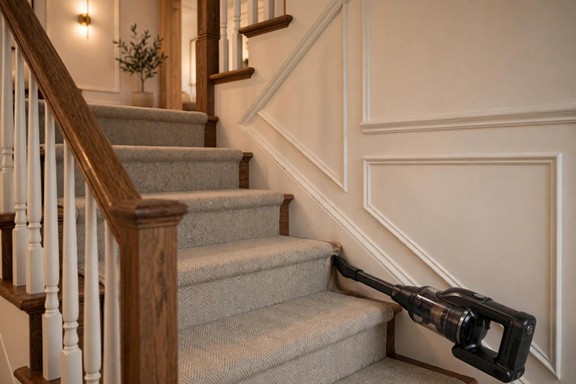
Every home has them: the places the main vacuum never quite reaches. The middle steps of the staircase, the dark line where the skirting board meets the floor, the gap between the sofa and the wall, the car boot. These neglected zones collect an astonishing amount of dust — and they’re exactly where a compact, manoeuvrable vacuum earns its keep. Here’s how to clean the awkward spots properly.
Stairs: top down, one step at a time
Stairs are the most-cleaned-badly surface in most homes. Dragging a full-size vacuum up and down is awkward and genuinely risky — the machine teeters, the hose snags, and gravity does the rest. The right approach is a lightweight handheld and a simple system: start at the top step and work down, so dislodged dust falls onto steps you haven’t cleaned yet.
For carpeted stairs, use a motorised brush head and give each tread two slow passes — one forward, one back. For the risers (the vertical faces), a quick pass with the crevice tool picks up the dust line that forms along each edge. This is precisely the job a **best handheld vacuum for stairs** is built for: light enough to hold one-handed on a staircase, with the right attachments for treads, risers, and the awkward triangle where each step meets the wall. Clean carpeted stairs weekly — grit works into carpet fibres fast and wears them out from the inside.
Corners and edges
The perimeter of every room is a dust highway. Air circulation pushes fine particles toward the edges, where they settle along skirting boards and in corners. Your vacuum’s main head can’t reach within about three centimetres of a wall — that’s physics, not a design flaw — so edges need the crevice tool, held at a slight angle and moved slowly. Slowly is the key word: rushing the crevice tool just stirs dust up instead of capturing it.
Once a month, go further: run a damp microfibre cloth along the skirting boards themselves. Vacuuming removes the loose dust; the damp cloth removes the fine film that vacuuming leaves behind, especially in kitchens where airborne grease makes dust sticky.
Upholstery seams and tight spots
Sofa seams, the gap between seat cushions, the space behind the television, under the bed — these are the dust reservoirs of the house. The technique is the same everywhere: crevice tool, slow passes, and for fabric, the upholstery nozzle with short overlapping strokes. Flip your sofa cushions monthly and vacuum the deck beneath; you’ll be surprised — possibly horrified — by what has accumulated there.
The same kit works in the car. A handheld with a crevice tool handles the seat rails, the boot corners, and the perennial mystery crumbs under child seats in about ten minutes.
Keep the suction you paid for
Here’s the part most people skip: awkward-spot cleaning puts unusual strain on a vacuum. Stairs and crevices force the motor to work harder against restricted airflow, and the fine dust from edges clogs filters faster than ordinary floor dirt. If your handheld seems to be losing power, check the filter before you blame the battery.
Many modern handhelds use washable filters, which is good news for your wallet — but only if you actually wash them. Rinse under cold water once a month, let the filter air-dry for a full 24 hours (a damp filter breeds mould and kills suction), and replace it once a year even if it looks fine. The trade-offs are worth understanding: **washable filters in handheld vacuums** save money and reduce waste, but they demand proper drying time and eventually wear out. Knowing the pros and cons helps you maintain them correctly instead of discovering the cons by accident.
The bottom line
The difference between a house that looks clean and a house that is clean lives in the awkward spots. A compact vacuum with the right attachments, used with a simple top-down system and maintained with clean filters, handles stairs, corners, and crevices in minutes. Give the neglected zones the same attention as the open floors, and the whole home feels different.
Marry Marlowe is a home cleaning specialist with 15 years of experience in vacuum care and home maintenance. She founded Vacuum Intel (vacuumintel.com) to help readers choose the right vacuum, use it effectively, and maintain it for years.
Image by https://vacuumintel.com/