

An app can replace the waiting in Indian matchmaking, but not the wisdom of a family astrologer. For generations, no rishta moved forward until the family astrologer had spoken. A handwritten janam kundali travelled between households, a pandit opened the panchang, and his verdict shaped every conversation that followed.
Today, many families open a phone instead. Choosing to kundali match online has become a normal step in the search for a life partner, and it raises a fair question: can software really stand in for a trusted astrologer? Let us look at what each does best.
The Family Astrologer: More Than a Calculator
The family astrologer was never just someone who counted points. He knew the families, often across generations. He remembered an uncle’s kundali, understood why a grandmother worried about a particular dosha, and could soften difficult news with context. Matching horoscopes was part calculation and part counselling.
The method itself is Ashtakoot Milan, which compares eight factors, called kootas. Together they add up to 36 gunas. The weakness of the old system was access. Families in small towns, or those settled abroad, often struggled to reach a trusted astrologer in time.
| Koota | Maximum points | What it looks at |
| Varna | 1 | Temperament and work attitude |
| Vashya | 2 | Mutual influence and adjustment |
| Tara | 3 | Birth-star harmony and wellbeing |
| Yoni | 4 | Natural and physical compatibility |
| Graha Maitri | 5 | Mental closeness, from the Moon sign lords |
| Gana | 6 | Basic nature and behaviour |
| Bhakoot | 7 | Emotional bond and family welfare |
| Nadi | 8 | Health and constitution of the couple |
| Total | 36 |
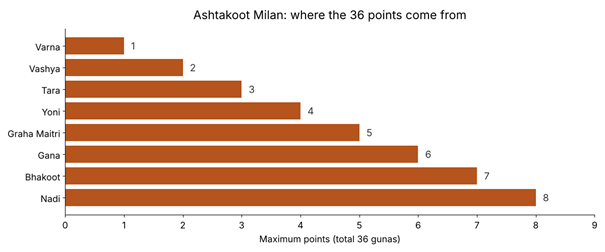
Maximum points for each of the eight kootas in Ashtakoot Milan. Original graphic created by the author.
Why Online Kundali Matching Is Rising
The shift is less about doubting tradition and more about convenience. Several things are driving it:
- Speed: A score arrives in seconds, not after a week of phone calls.
- Access: NRIs and families in smaller towns no longer depend on one local pandit.
- Privacy: Young people can check a match quietly before involving the whole family.
- Transparency: Users can see how each of the eight factors contributes to the total.
- Cost: A first screening is usually free or inexpensive.
As more rishtas begin on matrimonial platforms, the kundali check has moved to the same screen as the biodata.
What an App Does Well
Software is excellent at repeatable mathematics. From the date, time and place of birth, it can work out the Moon sign, nakshatra and a full 36-guna score without arithmetic slips. On platforms such as Astroma, families can kundali match online by entering both partners’ birth details and reading a factor-by-factor breakdown at their own pace, then share it with elders.
This makes an app a sensible first filter. A family can shortlist profiles, discard obvious mismatches, and go to an astrologer only with the promising ones.
There are two cautions. First, every result depends on the birth details entered. A small error in birth time can shift the Ascendant or the Moon’s nakshatra pada, and the score changes with it. Always use details from a birth certificate or hospital record.
Second, not every tool calculates in exactly the same way. Apps can use different settings, such as the ayanamsa (Lahiri is the most common), so two of them may give slightly different results for the same birth details. If the numbers differ, ask which settings were used before drawing a conclusion.
Where the Family Astrologer Still Matters
A number such as 24 out of 36 cannot tell a family whether to proceed. Judgement still belongs to a person who can:
- Interpret the score: A modest total with strong Graha Maitri may read very differently from the same total with a Nadi concern.
- Weigh doshas properly: Manglik and similar doshas often have recognised cancellations that a basic score does not show.
- Read the whole chart: The seventh house, dasha periods and planetary strengths go well beyond guna matching.
- Offer guidance with empathy: Marriage is an emotional decision, and families often need reassurance as much as information.
- Suggest remedies and a muhurat: These depend on personal and regional practice.
As a Jyotish Acharya, I treat the guna score as the start of a conversation. I look at the seventh house and the running dasha before I say anything about whether a match is suitable.
How to Use Online Kundali Matching Wisely
- Confirm both birth details from official records before entering them.
- Treat the online result as a first screen, not the final verdict.
- Read the breakdown of each factor, not just the total score.
- Discuss any dosha with a qualified astrologer before accepting or rejecting a match.
- Remember that values, communication and family understanding matter as much as any horoscope.
Partners, Not Rivals
An app will not replace the family astrologer, and it was never meant to. Technology has made it easy to kundali match online, saving time and widening access for families everywhere in India and abroad. The astrologer brings context, experience and a human voice to what the numbers cannot say. Used together, the two help families approach marriage with both tradition and clarity.
Disclaimer: Kundali matching is a traditional guidance system. It should support, not replace, open discussion between the two people and their families.
About the Author
Madhav Shukla is a Jyotish Acharya who writes on Vedic astrology and Indian marriage traditions. He works with Astroma.
Photo by Darshan Dave from Pexels (Free for Commercial use)
Image published by Dec 3, 2024
Image by https://astroma.co/